































Choose language:
Tech-Facilitated Gender-Based Violence: Derechos Digitales and UNFPA presented their new research in a webinar with Thelma Fardin
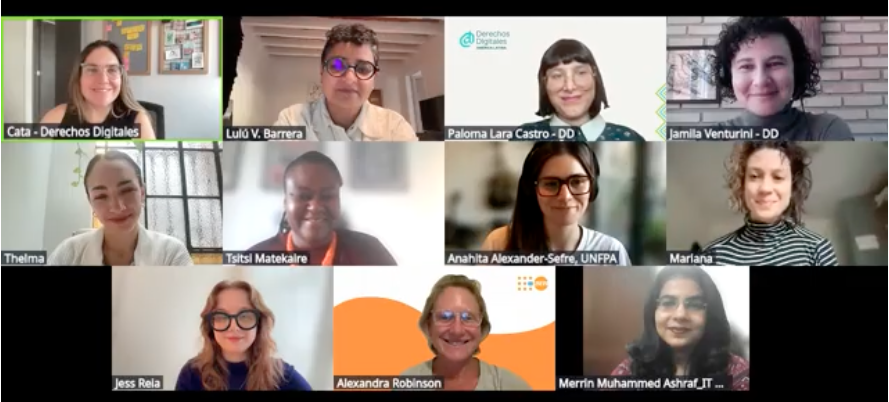
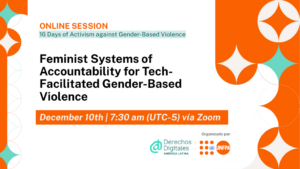
As part of the United Nations campaign “16 Days of Activism Against Gender-Based Violence” and Human Rights Day, on December 10th Derechos Digitales and UNFPA held the webinar “Feminist systems of accountability for tech-facilitated gender-based violence.” The dialogue featured the special participation of renowned Argentine actress and activist Thelma Fardin, along with researchers and leaders from around the world. During the event, they presented the results of new research developed in two documents: a report on digital gender-based violence and a guide with recommendations for advancing toward more just, effective, and survivor-centered legal frameworks and public policies.
“It is not only our image on social media that is at stake, but our right to exist and express ourselves. Given how difficult it is to maintain public discussion, we withdraw -and are removed- and that impoverishes the debate. This level of digital harassment also has profound effects on our mental health”, said Fardin, creator of the Thelma Fardin Foundation.
The session was moderated by Jamila Venturini, co-executive director of Derechos Digitales, and the introduction was given by Alexandra Robinson, technical advisor on gender-based violence for UNFPA. Thelma Fardin was the keynote speaker, and the rest of the seminar was completed by: Paloma Lara-Castro, director of Public Policy at Derechos Digitales; Mariana Valente, co-founder and associate director of InternetLab (Brazil); Lulú Barrera, co-director of Fondo de Semillas (Mexico); Tsitsi Matekaire, global lead for ending sexual exploitation at Equality Now (Zimbabwe); Jess Reia, professor at the University of Virginia; and Merrin Muhammed Ashraf, senior associate and researcher at IT for Change (India).
Venturini presented the general framework: “The idea is to move from a model law to different guiding principles that can be adapted to different contexts. We can reflect historical demands from activism and feminism there.” Robinson expressed a similar sentiment at the beginning of the seminar: “We are proposing a guiding framework that can be used globally to support laws that are restorative, build resilience, and support feminist strategies. We need to accompany each other around the world and promote accountability systems.”
The webinar served as a launch pad for two documents prepared by Derechos Digitales and UNFPA. One was the report “Combating tech-facilitated gender-based violence (TFGBV) from an international human rights law perspective,“ and the other was the guide “Guiding principles for legislative and public policy reform in response to tech-facilitated gender-based violence: towards an accountability system.” Together, these publications propose a framework for legislative reform based on human rights and intersectionality, and centered on survivors. They are based on a comprehensive review of international human rights law frameworks, a comparative analysis of eight national laws, and input from an advisory board of experts from around the world.
Why do we need multiple legal avenues to respond to TFGBV and a systemic approach centered on survivors? Mariana Valente of InternetLab and Lulú Barrera of Fondo de Semillas discussed this question in one of the session’s rounds. “The criminal justice system is not there to protect victims and survivors. We need a comprehensive protection system, and this is something that is still very much lacking in public policies at the regional level”, said Valente. Barrera added another important element to consider: “How do we transform masculinities? They are primarily responsible for online gender-based violence, so we also need to promote prevention campaigns targeting this sector.”
Tsitsi Matekaire of Equality Now and Jess Reia of the University of Virginia then discussed how digital violence intersects with structural inequalities in the Global South, including those of race, class, gender identity, sexual orientation, and political marginalization. “TFGBV does not appear out of nowhere; it is something that arises from inequality in the lives of women, girls, and gender-diverse people. These inequalities are much more visible in communities or countries in the Global Majority”, said Matekaire. “Many institutions focused on gender-based violence are not really prepared to receive gender-diverse people. Bureaucracy and intimidating procedures can be really harmful. So there is a mistrust of the system and institutions that is completely understandable”, added Reia.
Finally, a roundtable discussion was held to reflect on the state’s capacity to respond to TFGBV without resorting to punitive, moralizing, or surveillance-based approaches. “Victims find it very challenging to identify with specific laws, but also to approach the judicial system to report a crime. It is important to highlight that violence and exclusion are also exercised in legislation. The responses provided by states are ineffective”, warned Paloma Lara-Castro of Derechos Digitales. Complementing this perspective, Merrin Muhammed Ashraf of IT for Change stated: “The language of the law has a strong implication on what happens in the judicial system when a case goes to trial. It is paternalistic language, and this is validated in the courts, an environment that should be in favor of victims.”
Watch the full recording of the webinar on Derechos Digitales YouTube channel.
The research document can be downloaded at this link, while the guide with the principles is available here. The publications are in English and will soon be available in Spanish as well.